The future moves
A field-control research platform investigating whether engineered electromagnetic asymmetry can create useful directional force, propulsion and protective field interactions.
- Discipline
- Field control
- Power
- Externally supplied
- Highest stage
- Model
- Next milestone
- Vacuum force test
Statement of record
“Quantus® is investigating whether controlled electromagnetic field asymmetry can create useful directional force and protective field effects. The technology is currently progressing through prototype development and independent laboratory validation.”
This is the approved public description of Quantus®. Everything else on this page is written to stay inside it. Where a statement goes beyond what has been measured, it is marked as a concept or a model — never as a result.
One platform.
Multiple frontiers.
Most technologies are built to do one thing. Quantus® is being developed around a more fundamental capability: controlling how electromagnetic fields are shaped, biased and directed.
If validated at useful scale, that capability could open an unusually broad application space — from movement and stabilisation to shielding, interception support and disaster mitigation. The underlying phenomenon is under validation, so every entry below is a research pathway contingent on successful validation and scale-up, and carries the stage its evidence currently supports.
- 01
Space Propulsion
Validation stage: MODELContinuous field-based propulsion concepts for orbital manoeuvring and deep-space transit. Mission timelines remain projections until thrust-to-power performance is measured.
- 02
Missile & Interceptor Systems
Validation stage: CONCEPTPotential field-control applications supporting next-generation interception, guidance resilience and high-speed payload architectures. No operational capability is claimed.
- 03
Protective Shielding
Validation stage: CONCEPTResearch into whether field-mediated redirection or attenuation of selected energetic, particulate or electromagnetic threats is achievable at useful scale.
- 04
Drone Lift & Mobility
Validation stage: CONCEPTPotential lift augmentation, stationkeeping, stabilisation and endurance improvements for unmanned systems. The near-term target is measurable force augmentation, not rotor replacement.
- 05
Automotive Safety
Validation stage: CONCEPTConcepts for collision-force mitigation, vehicle stabilisation and pre-impact intervention. A long-term safety research direction, not a production claim.
- 06
Wildfire Mitigation
Validation stage: CONCEPTResearch concepts for manipulating airflow, embers and localised particulate movement around critical assets, alongside conventional suppression.
- 07
Coastal / Wave Mitigation
Validation stage: CONCEPTLong-range research into field-assisted redirection of conductive debris, charged aerosols or local flow conditions near critical coastal infrastructure.
- 08
Aerospace Survivability
Validation stage: CONCEPTPotential management of charged particles, plasma interactions, selected debris environments and electromagnetic disturbances around spacecraft and high-altitude vehicles.
How to read the badges
Every specific capability claim on this site carries a validation stage. The ladder runs from an idea on paper to a system in the field. Quantus® is near the bottom of it, and says so.
- CONCEPT
- MODEL
- TEST ARTICLE
- LAB RESULT
- INDEPENDENTLY REPLICATED
- DEPLOYED
Stages shown dim have not been reached. Nothing published by Quantus® currently sits above MODEL.
Control the field. Change the outcome.
Quantus® is an experimental field-control architecture designed to investigate whether engineered asymmetry can create useful directional force and protective field behaviour. Conventional magnetic systems are usually engineered for symmetry and predictability; Quantus® deliberately explores the opposite condition — controlled, measurable asymmetry.
The central question is simple and testable: can a deliberately asymmetric field configuration create a repeatable directional effect that survives rigorous artifact controls?
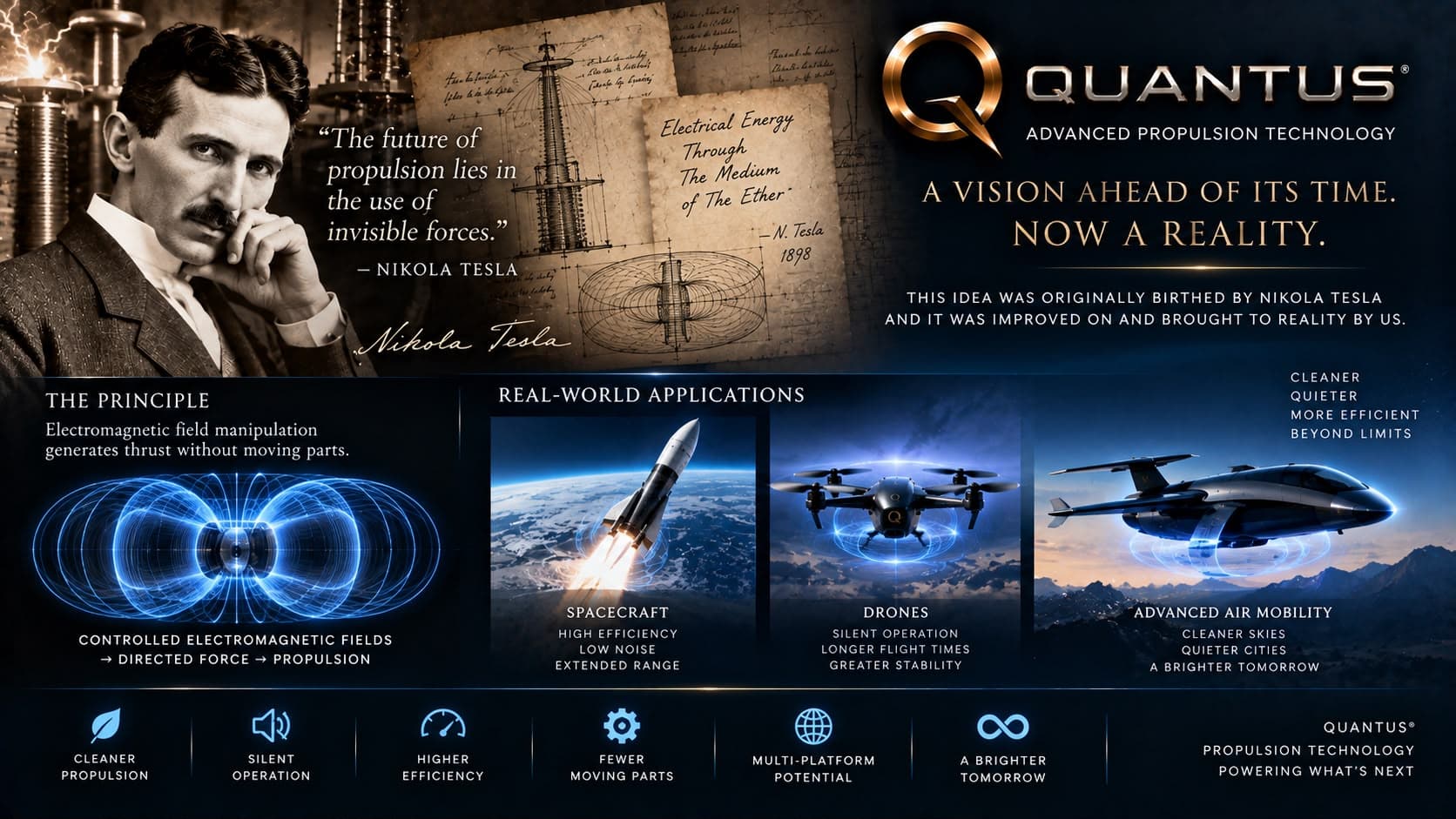
Concept render — illustrative only
The left of this plate shows the shape of the question: geometry-driven field gradients, switchable between a symmetric control state and an asymmetric experimental state. The vehicles on the right are concept applications that would only become relevant after a directional effect is measured, replicated and scaled.
Quantus® does not claim a working propulsion device. The honest status of the underlying phenomenon is: unproven, and being tested.
Artwork is a commissioned visualisation. Any headline text, labels or instrument readings appearing inside the image are artistic elements, not measured results, and are not claims made by Quantus®.
The research stack
- Asymmetric electromagnetic field generator
- High-speed pulsed-power electronics
- Aureum™ supercapacitor power buffer
- 3-axis field mapping with synchronised electrical instrumentation
- Hard-vacuum thrust and torsion measurement
- Thermal and EMI artifact rejection
- Advanced material amplification studies
Described at the public-marketing level only. This site deliberately contains no dimensions, winding data, drive waveforms or schematics.
What Quantus is not
Quantus® is not an energy-generation claim. It requires an external power source.
The research objective is force and field control — not free energy, not perpetual motion, and not exemption from conservation laws. Advanced materials under study, including chiral magnetics, magneto-electric compounds, multiferroics, altermagnets and engineered metamaterials, do not create energy either. Their potential value would be in changing coupling, field concentration, nonreciprocity or directionality.
Anything a Quantus® system might one day do, it would do by spending power that something else supplied.
Built to be falsifiable.
The standard is not a compelling animation. It is repeatable measurement. Quantus® testing is designed to distinguish a genuine directional force from thermal drift, vibration, cable forces, electromagnetic coupling and instrumentation artifacts — the effects that have explained away most claims in this field before.
Extraordinary technology requires ordinary discipline. The test programme below is the part of Quantus® that is meant to be boring.
- S1
Baseline Characterisation
Map magnetic fields, electrical behaviour, thermal response and mechanical stability in air, under controlled low-power conditions.
- S2
Hard-Vacuum Force Testing
Operate the test article on a calibrated torsion pendulum or micro-thrust stand under hard vacuum.
- S3
Falsification Controls
Symmetric null runs, field-polarity reversal, 180° orientation reversal, dummy electrical loads, thermal-equilibrium runs, cable-force audits and blinded analysis.
- S4
Material Amplification
Compare the baseline article against chiral, magneto-electric and metamaterial-assisted configurations while holding geometry and test conditions constant.
- S5
Independent Replication
If a reproducible signal is found, the same protocol is repeated at a second qualified facility that we do not control.
What a first result would mean
A successful first-stage result would not prove every future application. It would establish the underlying phenomenon. From there, the programme scales through materials amplification, higher power density, thermal management, control systems and application-specific engineering — each of which can fail on its own terms.
What a null result would mean
If the symmetric null runs, polarity reversals and blinded analyses cannot be separated from the experimental condition, there is no effect to scale. That outcome is a legitimate result of this programme, and it is one the test design is built to detect rather than avoid.
Where a validated effect could go.
The following are research pathways, not products. They are presented with commissioned visualisations because the scale of the idea matters — and with precise language because the evidence does not yet support any of them.
Read every image on this page as an illustration of intent. Read every caption as the claim of record.
Defense & Security
Validation stage: CONCEPTFuture threats move faster, operate across more domains and put greater pressure on conventional defensive systems. Quantus® is investigating whether controlled fields could become an additional layer in sensing, survivability, interception support and platform protection — alongside, not instead of, the systems that already work.
Research areas
- Strategic missile-defense support and interceptor survivability
- Electromagnetic and EMP resilience
- Platform shielding against selected particles, fragments and debris
- Counter-UAS and non-contact control concepts
- Field-assisted stabilisation and manoeuvring
Explicit limitation
Quantus® does not claim current operational capability in any of these areas. Defense applications would require independent validation, government testing, safety review and application-specific engineering. Quantus® is an independent research programme and has no affiliation with any defense agency, national missile-defense initiative, space agency or university.
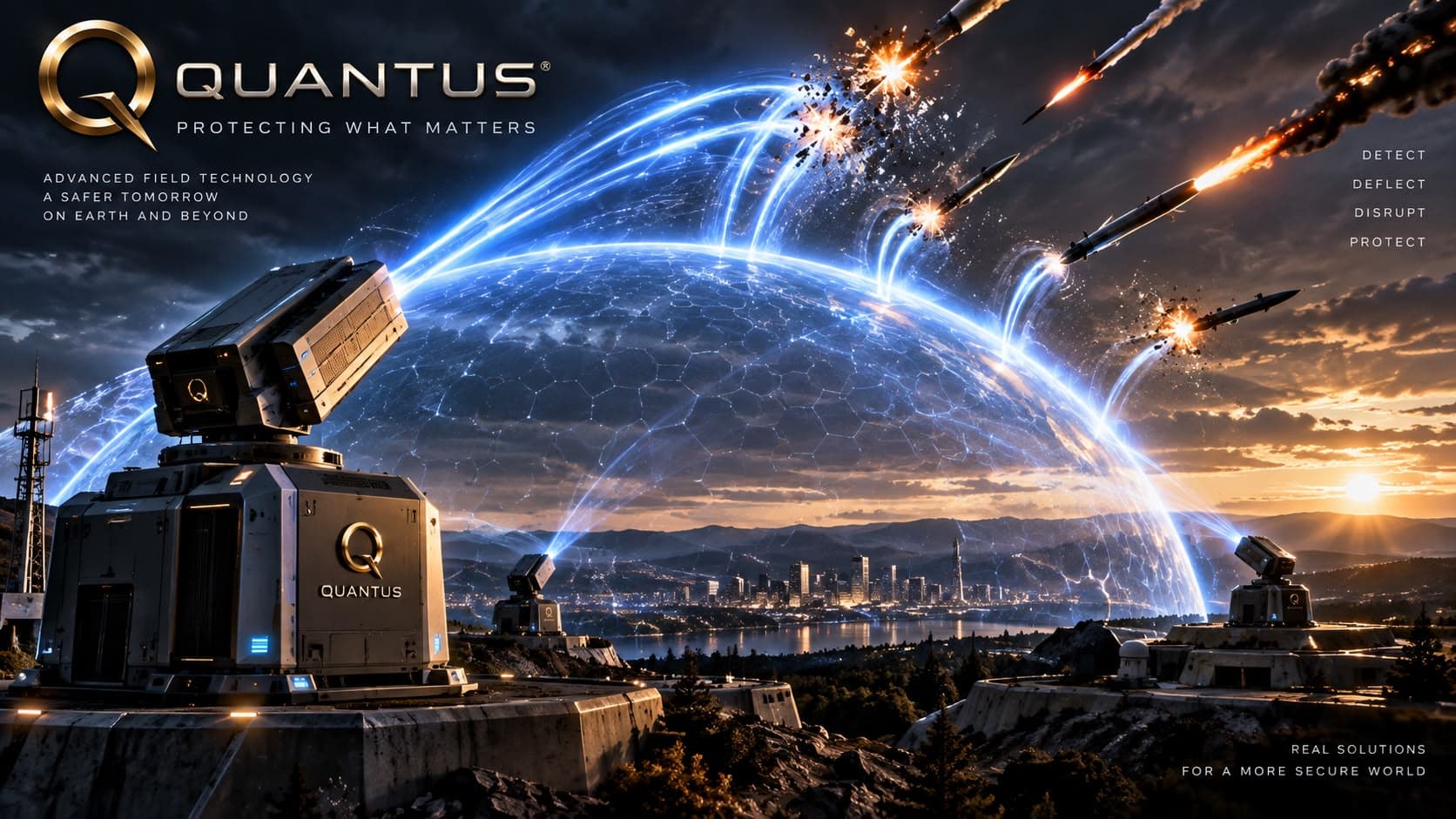
Concept render — illustrative only
A visualisation of the ambition: distributed emitters maintaining a protective field volume over infrastructure. Nothing of this kind exists. Quantus® has not demonstrated interception, redirection or attenuation of any munition, and is not represented as a deployed missile-defense system.
What is real today is the question underneath the picture — whether controlled field asymmetry produces a measurable directional effect at all.
Artwork is a commissioned visualisation. Any headline text, labels or instrument readings appearing inside the image are artistic elements, not measured results, and are not claims made by Quantus®.
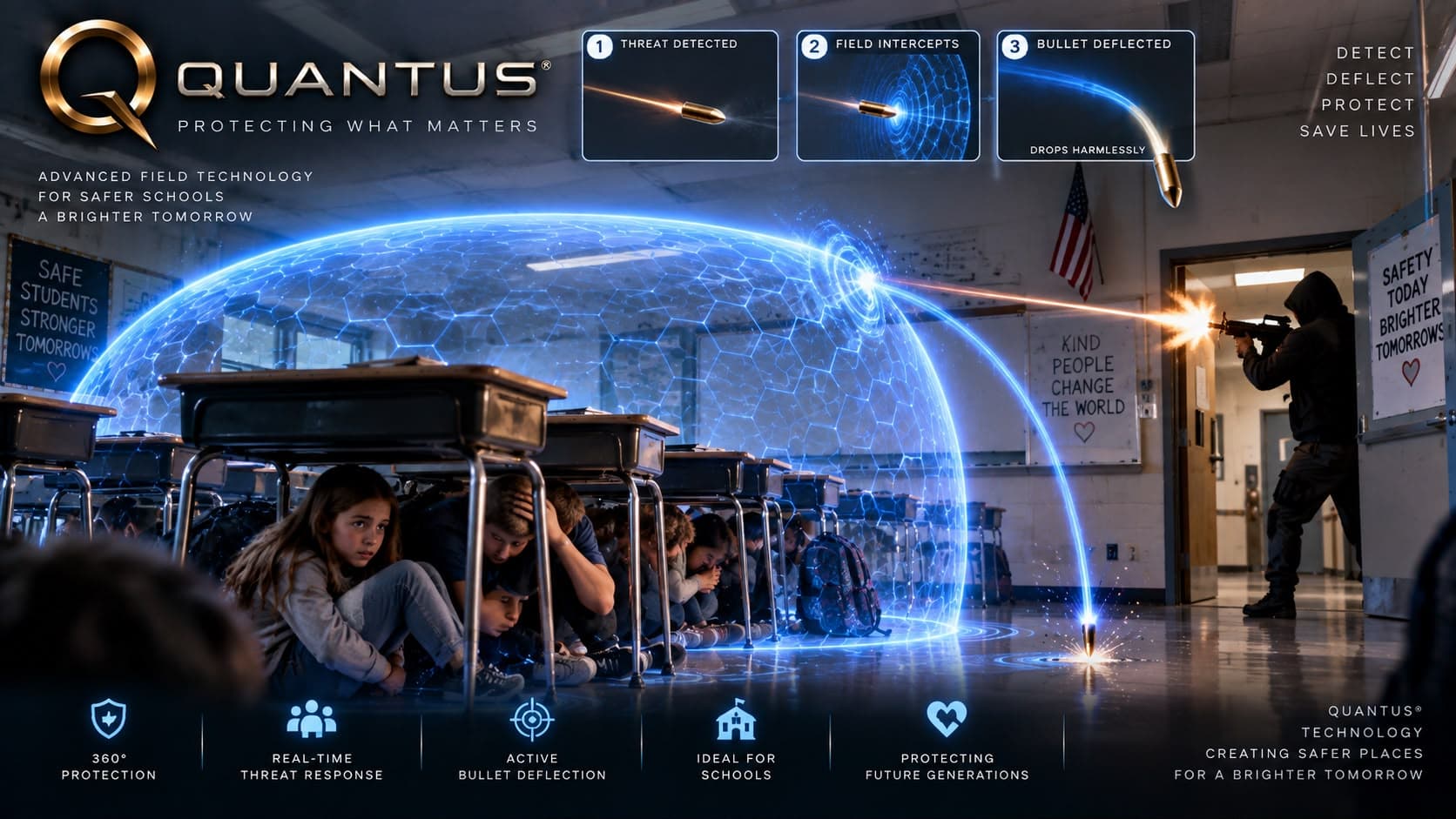
Concept render — illustrative only
This is the application people ask about most, and the one that most needs plain language: Quantus® does not stop bullets. No field-based protective system has been built, tested or validated by Quantus® against any projectile.
The underlying research question is narrower and more honest: whether strong, rapidly controlled fields can influence magnetically responsive projectiles, fragments or conductive debris at all. Any effect would vary by material and geometry and would require controlled ballistic testing by an independent facility before it could be described as protection.
Artwork is a commissioned visualisation. Any headline text, labels or instrument readings appearing inside the image are artistic elements, not measured results, and are not claims made by Quantus®.
Propulsion & Sub-Surface Mobility
Validation stage: CONCEPTConventional propulsion moves a vehicle by moving mass. A field-based approach would aim to produce directional force without a mechanical drive train — which, if it worked, would change acoustic signature, cavitation behaviour and maintenance profile as much as it changed speed.
That is the concept. The measurement that would justify it has not been made.
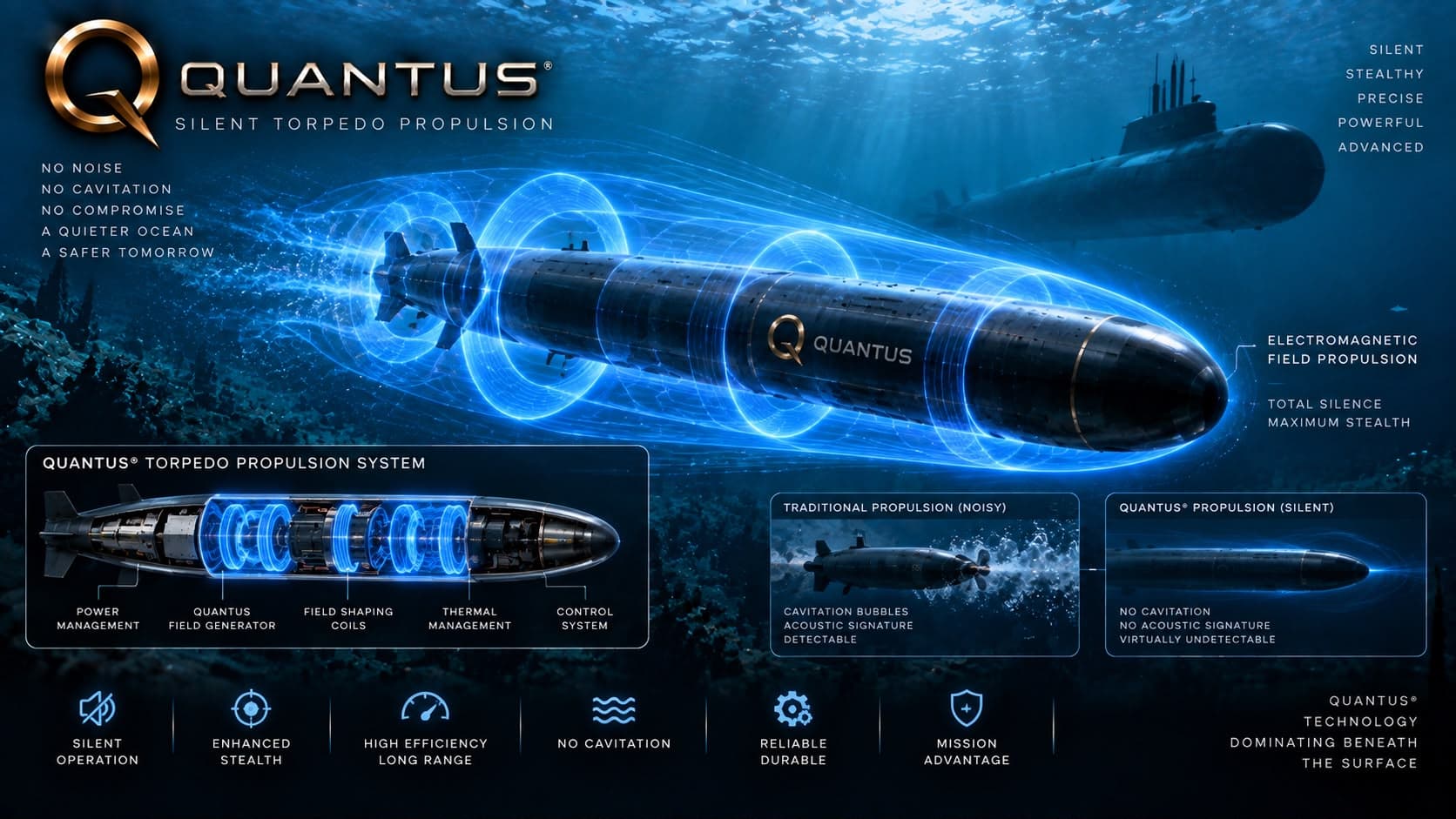
Concept render — illustrative only
A concept for a sub-surface vehicle driven by shaped fields rather than a propeller. The cutaway is illustrative block-level artwork, not an engineering drawing; no dimensions, coil data or drive parameters appear on this site.
Claims of silence, stealth or efficiency shown inside the artwork are aspirational. Quantus® has produced no measured acoustic, thrust or efficiency data for any such vehicle.
Artwork is a commissioned visualisation. Any headline text, labels or instrument readings appearing inside the image are artistic elements, not measured results, and are not claims made by Quantus®.
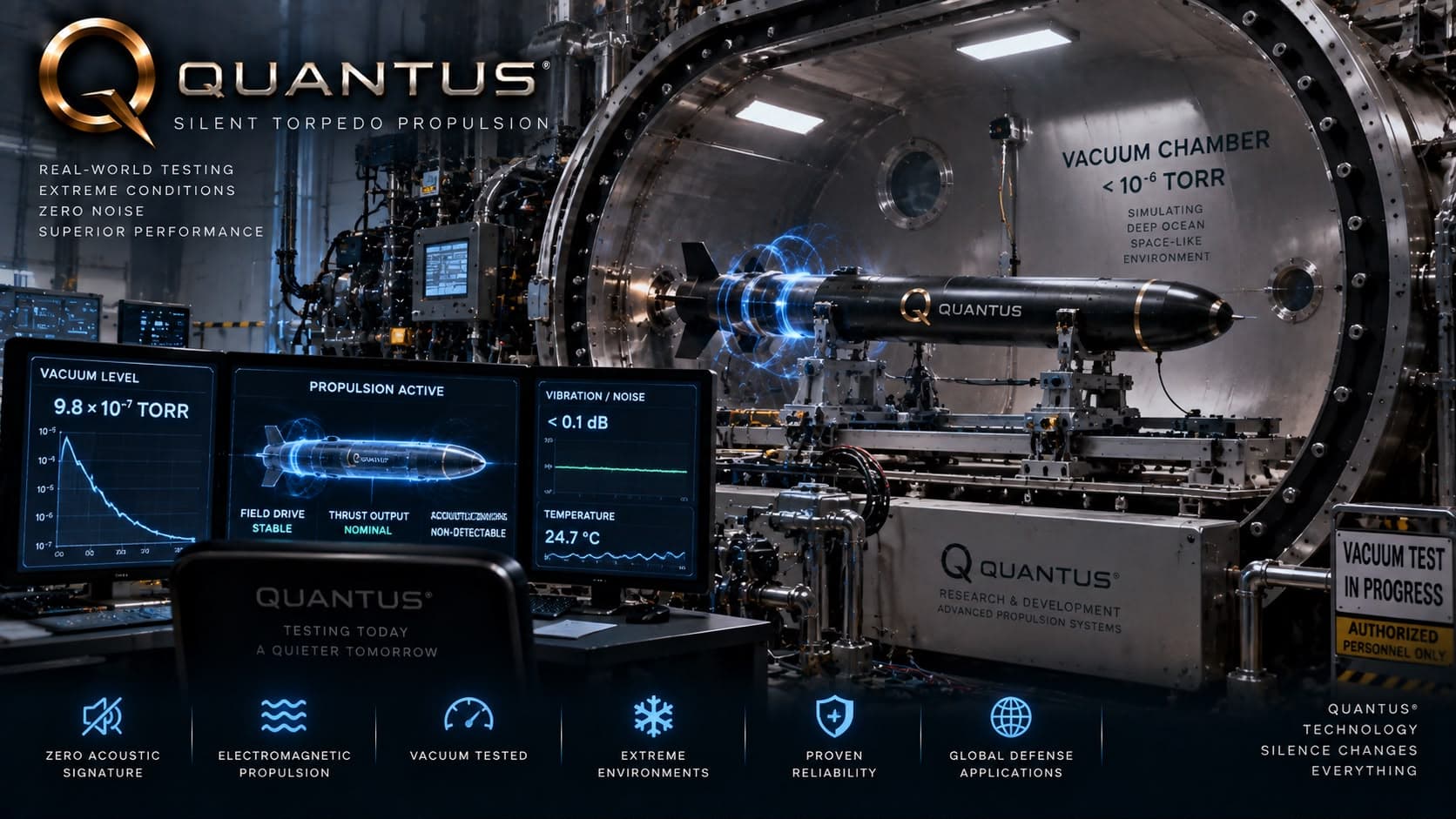
Concept render — illustrative only
This plate depicts the environment the programme is working toward: a test article instrumented inside a hard vacuum chamber, where thermal drift, cable forces and air currents can be excluded as explanations.
The chamber readings, vacuum levels and performance indicators visible in this artwork are illustrative set-dressing. They are not Quantus® measurements and should not be cited as data. Real figures will be published only once they exist, with the protocol that produced them.
Artwork is a commissioned visualisation. Any headline text, labels or instrument readings appearing inside the image are artistic elements, not measured results, and are not claims made by Quantus®.
Space
Validation stage: MODELChemical propulsion is extraordinarily capable, but every mission is constrained by propellant mass, burn duration and mission architecture. Quantus® is investigating whether controlled electromagnetic fields could add a fundamentally different option — continuous, low-thrust, propellant-free force.
Quantus® has modelled aggressive Mars-transfer sensitivity cases, including 30-, 20- and 10-day scenarios. These are engineering scenarios, not demonstrated mission capability. The decisive inputs are measured thrust, vehicle mass, continuous power availability, thermal rejection and sustained operating duration — and none of those have been measured for a Quantus® article.
Potential space applications
- Orbital stationkeeping and precision attitude control
- Continuous-thrust interplanetary transfer concepts
- Rapid repositioning of spacecraft
- Cargo movement between orbital platforms
- Deep-space probes and long-duration missions
- Debris-avoidance and protective field concepts
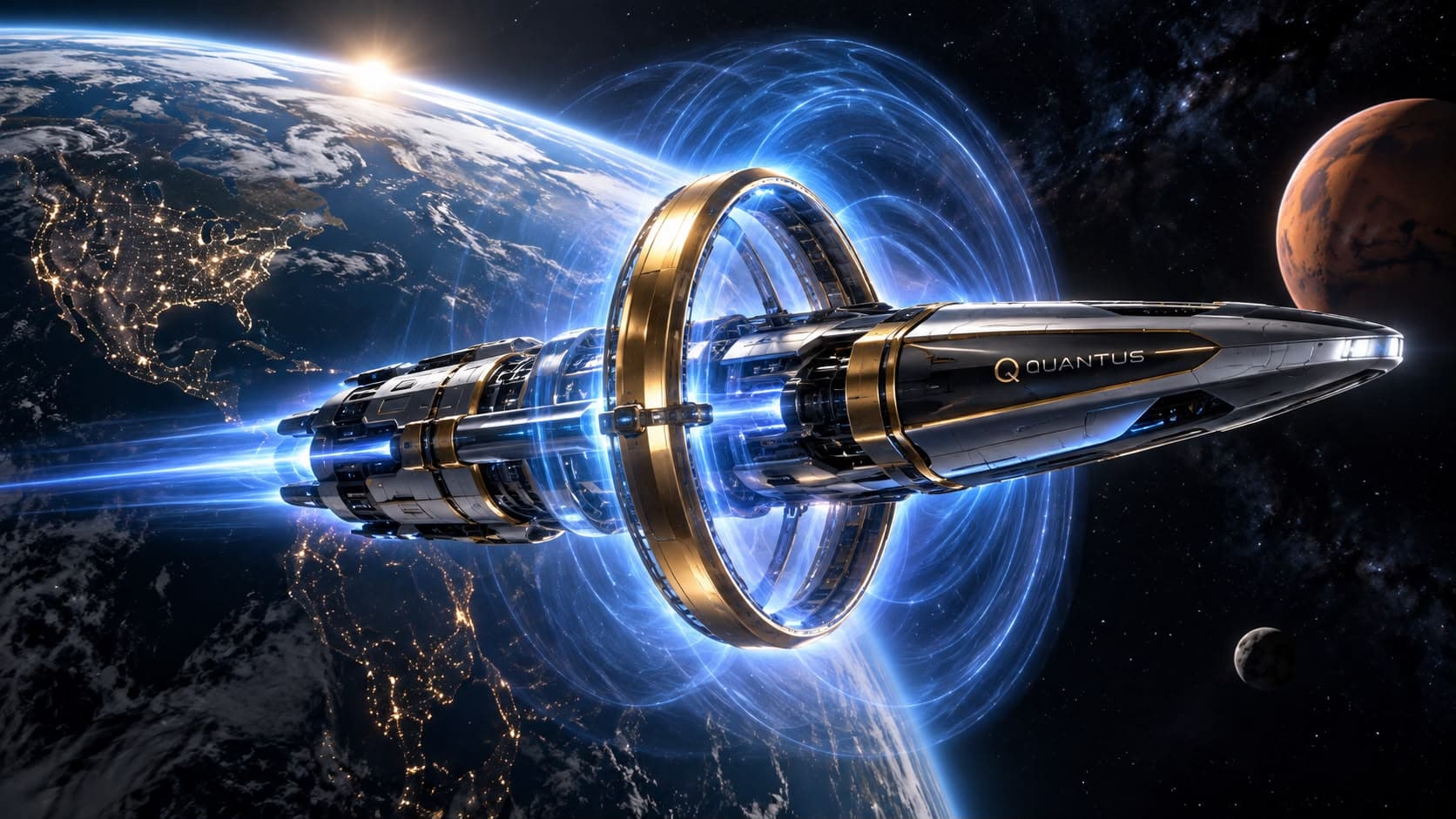
Concept render — illustrative only
A concept vehicle carrying the gold ring and blue field geometry of the Quantus® mark. It is badged MODEL rather than CONCEPT because the mission scenarios behind it — transfer times, power budgets, thermal loads — have been worked through numerically.
A model is not a measurement. Every one of those numbers depends on a thrust-to-power figure that has not yet been obtained on a bench, let alone in flight.
Artwork is a commissioned visualisation. Any headline text, labels or instrument readings appearing inside the image are artistic elements, not measured results, and are not claims made by Quantus®.
Automotive Safety
Validation stage: CONCEPTFuture vehicle systems could combine predictive sensing with fast field-control responses. Research targets include attitude stabilisation before impact, reduction of secondary collisions, and interaction with selected conductive or magnetic structures.
This is a long-term safety research direction. It is not a production claim, and no Quantus® system has been fitted to or tested in a vehicle.

Concept render — illustrative only
The scenario is deliberately dramatic; the research question is not. It is whether a rapidly controlled field can measurably alter vehicle attitude or influence selected collision dynamics in the milliseconds before impact.
Any such system would complement structural crash engineering, restraints and existing driver-assistance systems — never replace them — and would require crash testing and regulatory approval long before it reached a road vehicle.
Artwork is a commissioned visualisation. Any headline text, labels or instrument readings appearing inside the image are artistic elements, not measured results, and are not claims made by Quantus®.
Disaster Mitigation
Validation stage: CONCEPTQuantus® research is not limited to vehicles. Controlled fields may eventually become tools for protecting infrastructure from fast-moving environmental threats. Both directions below are early-stage research concepts, and the coastal one in particular is a long-range hypothesis rather than an engineering programme.
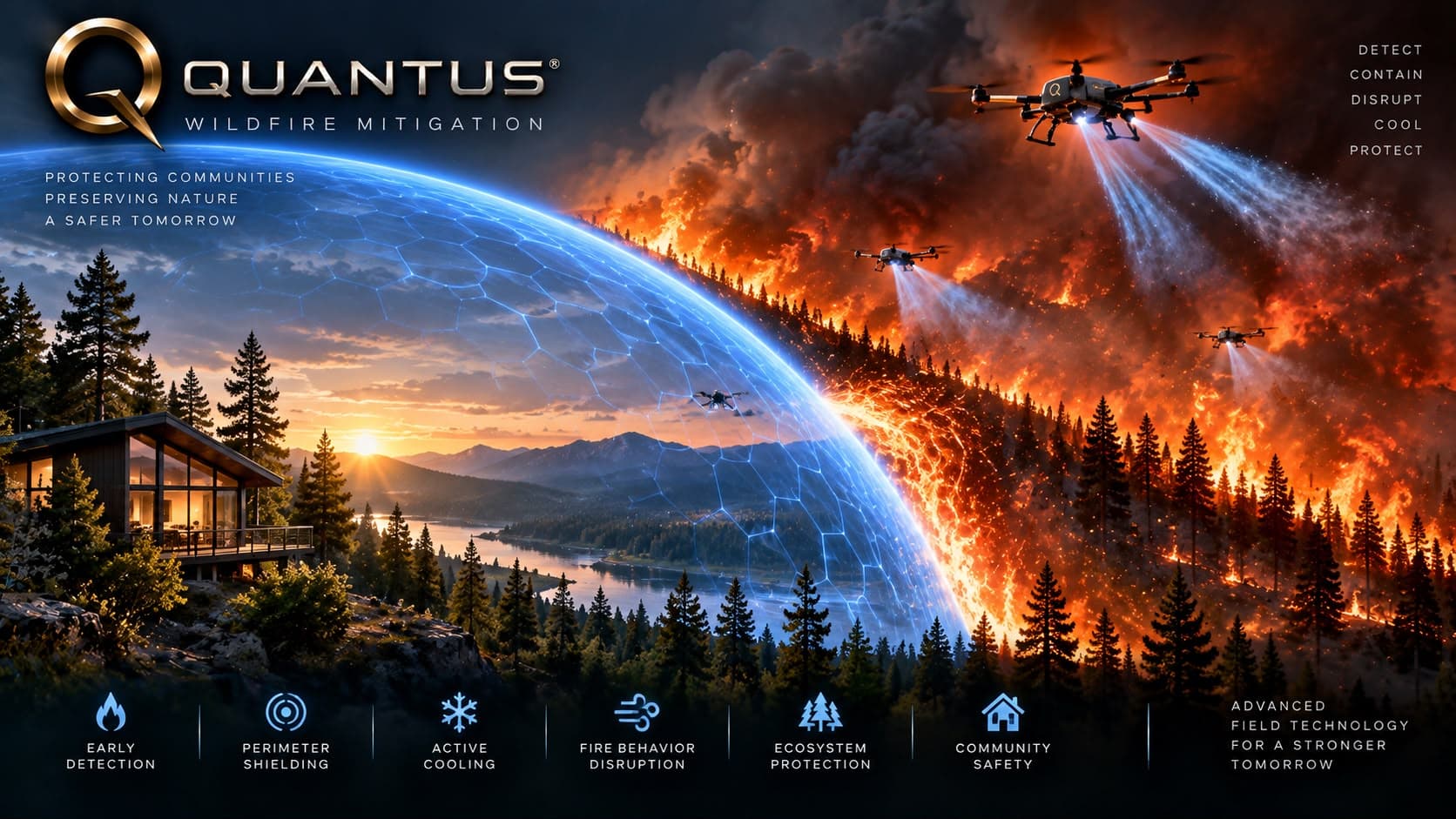
Concept render — illustrative only
One research direction is localised control of charged smoke particles, embers and airflow around structures or strategic corridors. The objective would be to add a field-based protective layer alongside defensible space, suppression systems and fire-resistant construction.
Quantus® does not stop wildfires. Field technology would complement conventional suppression, not replace it, and no ember-transport or airflow effect has been demonstrated.
Artwork is a commissioned visualisation. Any headline text, labels or instrument readings appearing inside the image are artistic elements, not measured results, and are not claims made by Quantus®.
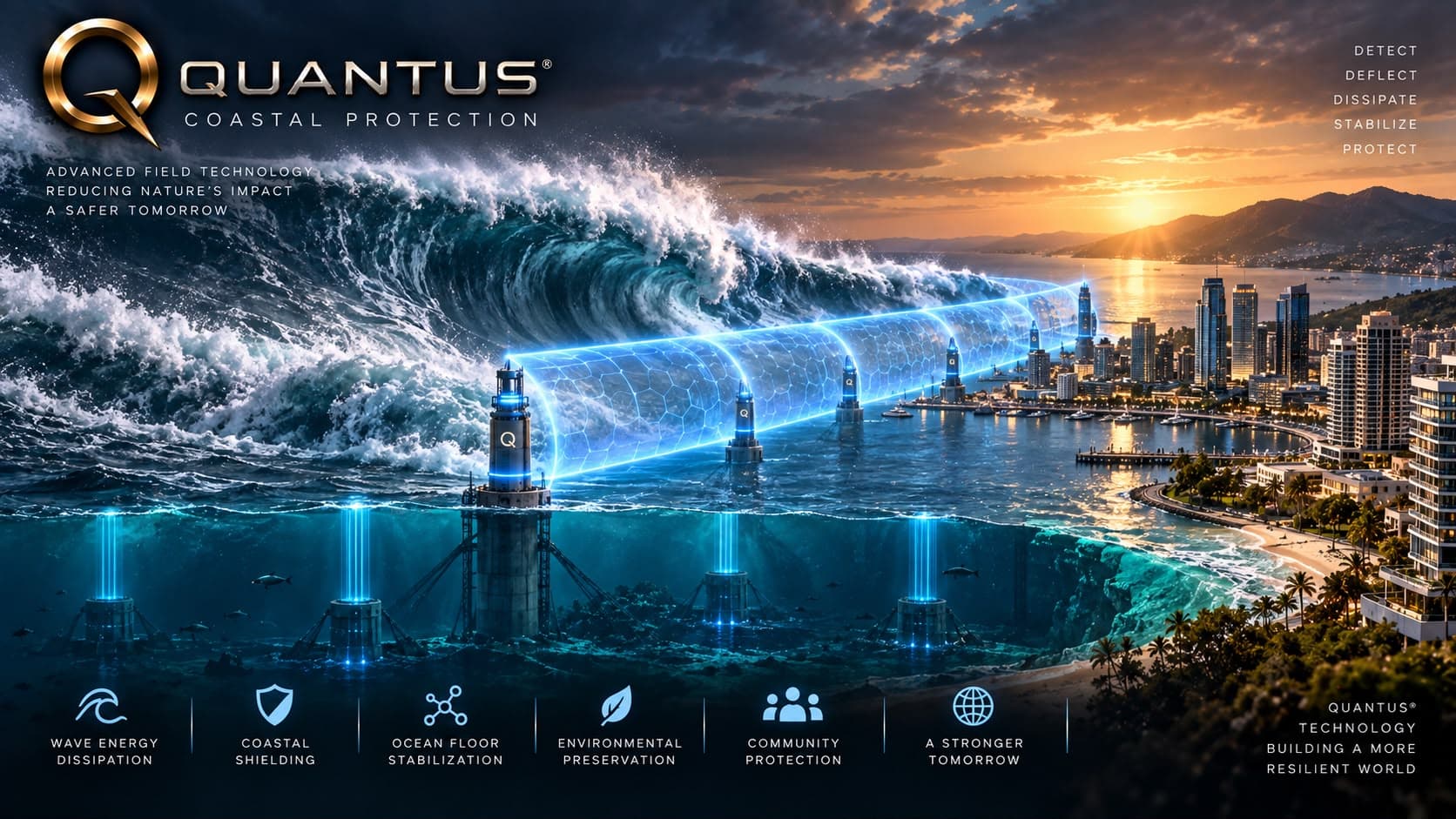
Concept render — illustrative only
The most speculative image on this page, and the one that needs the clearest caveat. Direct large-scale water-wave deflection is not established physics for Quantus® and is not claimed. This plate is a long-range research concept only.
What could plausibly be investigated at infrastructure scale is narrower: whether field-assisted systems can influence conductive debris, charged aerosols or localised flow conditions around fixed assets, or support conventional mechanical barriers during extreme coastal events. Even that would require extensive modelling before any test.
Artwork is a commissioned visualisation. Any headline text, labels or instrument readings appearing inside the image are artistic elements, not measured results, and are not claims made by Quantus®.
We are looking for the people who can prove it.
Quantus® is seeking organisations capable of rigorous validation and disciplined scale-up: qualified laboratories, advanced-materials researchers, magnetics manufacturers, aerospace engineers and strategic partners who understand long-horizon research.
01
Laboratories
Hard-vacuum chambers, micro-force metrology, torsion pendulums, field mapping and advanced instrumentation.
02
Materials Researchers
Chiral magnetics, multiferroics, altermagnets, skyrmions, magneto-electric materials and metamaterials.
03
Manufacturers
Precision nonmagnetic assemblies, high-current coils, pulsed-power electronics and vacuum-compatible fabrication.
04
Aerospace & Defense
Application modelling, platform integration, survivability studies and rigorous test planning.
05
Strategic Capital
Long-horizon partners who understand that foundational physics validation precedes commercialisation.
06
Build with us.
Request a collaboration brief and we will tell you exactly what we have measured so far — including the parts that have not worked.
The right test can change everything.
Tell us what you can measure, build or fund. Sensitive technical information is released only after qualification and NDA execution — please keep this first message at a general level.
Direct

Security notice
Quantus® publishes no manufacturing dimensions, coil-winding data, pulsed-power schematics or export-controlled technical information. Detailed technical material is shared through a gated data room after qualification, internal approval and NDA execution.
Build the thing that should not be possible —
then test it until there is no argument left.
The ambition is global. The discipline is equally important: theoretical potential is not treated as proven capability, and every major claim must ultimately be tied to measured data.